

A Federal Court Halts Trump’s White House Ballroom Without a Vote
Summary
A federal appeals court has ruled that construction of a 90,000 square-foot ballroom beside the White House cannot proceed without explicit congressional authorisation — a 2-1 decision that rebukes the Trump administration’s reading of executive authority over the property. The case, brought by the National Trust for Historic Preservation against the National Parks Service, turns on a pointed constitutional question: who, precisely, has the right to alter a building that belongs not to any one president but to the American public. The answer, for now, is Congress. Though perhaps not for long.
The Building That Keeps Rising
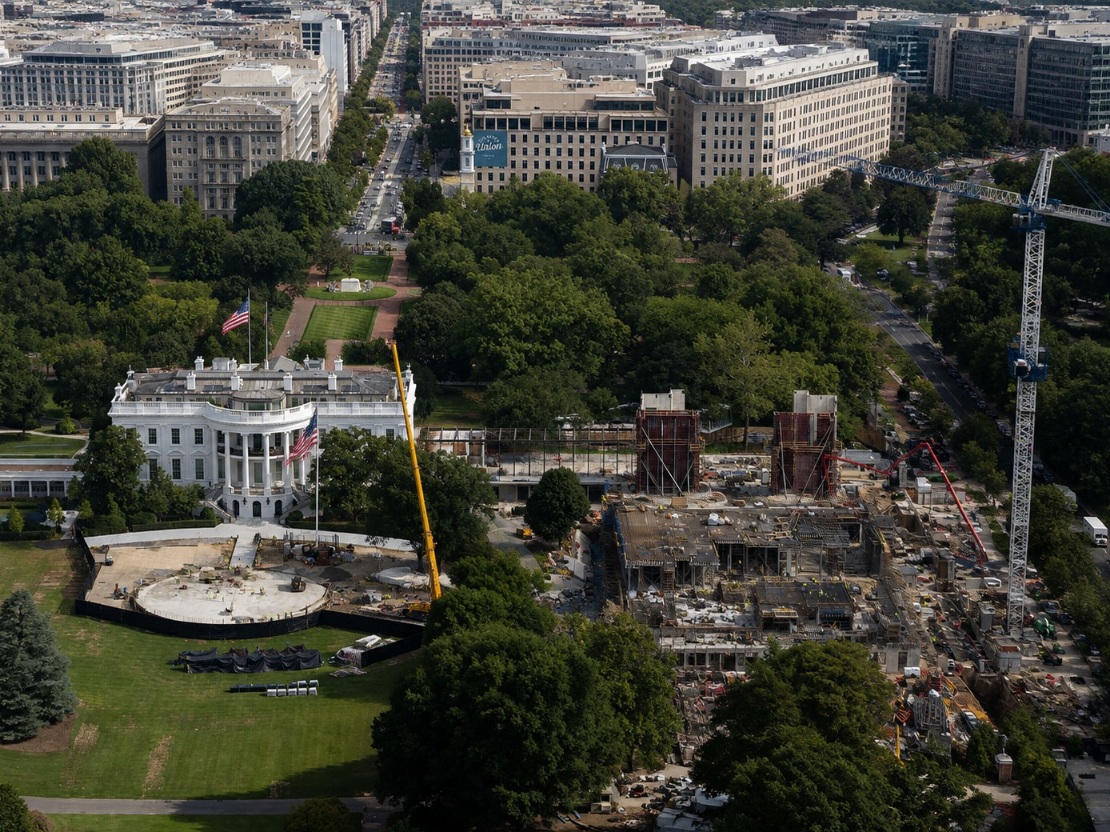
Work on the ballroom began last autumn and has continued steadily ever since — privately funded, expansive in ambition, and contested almost from the first day ground was broken. At roughly 8,360 square metres, the proposed structure would be a significant addition to the White House estate, designed to host the kind of large-scale events that the existing residence cannot comfortably accommodate. The administration has framed it as an enhancement. Critics, including the National Trust for Historic Preservation, have framed it as something rather different: an unauthorised alteration to one of the most scrutinised pieces of real estate in the world.
The Court’s Position
The ruling, handed down Friday by a three-judge panel from the U.S. Court of Appeals for the District of Columbia Circuit, was not close in its reasoning even if it was close in its numbers. The majority’s language was deliberate. A president, the court wrote, is a temporary tenant of the White House — not its owner — and holds no constitutionally assigned authority over property maintained for the use of all presidents, present and future, and for the American people at large. The decision upheld an earlier district court injunction blocking the project, and gave the defendants 14 days to determine their next move.
A Preservation Argument at 250
The lawsuit was brought by the National Trust for Historic Preservation, a nonprofit with a long record of challenging development it considers incompatible with the historic character of significant American sites. Its president and CEO, Brent Leggs, called Friday’s ruling a landmark moment — and pointedly noted its timing. The United States is currently marking the 250th anniversary of the Declaration of Independence, a context that gives arguments about the stewardship of national heritage sites a particular resonance. For the Trust, the core legal position has always been straightforward: only Congress can authorise construction of this kind at the White House, and no executive decision can substitute for that approval.
The Supreme Court Gambit
Trump’s response came quickly and through his preferred channel. Writing on Truth Social within hours of the ruling, he announced that the administration would appeal immediately to the Supreme Court — bypassing the standard process of seeking further review at the circuit level. It is a characteristically direct escalation, and it signals that the administration intends to contest not just the injunction but the underlying constitutional interpretation that produced it. Whether the Supreme Court agrees to hear the case, and on what timeline, will determine how long the ballroom site remains idle. The structure has risen this far. Its builders appear to believe it will rise further still.
輸出正常。這篇英文政治新聞沒有需要括號標注的專有名詞(National Trust for Historic Preservation 已有對應中文譯名直接在摘要中處理),§3.2 規則運作正確。